GitLab Network Documentation
Last updated: August 1, 2026
Purpose: This document supports firewall change requests. It gives the network flow specifications for the connection between your self-hosted GitLab instance(s) and the Aisle SaaS platform.
Firewall rules are necessary for GitLab Self-Managed and GitLab Dedicated instances only. For GitLab SaaS (gitlab.com), see the section “GitLab SaaS” at the end of this document.
Summary
Bidirectional traffic is necessary.
Grouped firewall rules can cover more than one GitLab instance.
The rules enable repository analysis, fix merge requests, automatic merge request review (PR bot), CI validation, and webhook notifications.
Caution: The Aisle egress IP and the Aisle inbound address are two different things. The egress IP is the source of the Aisle-to-GitLab traffic (Rule 1). It is static. Allow it by IP. The inbound webhook destination (Rule 2) is the FQDN {customer}.app.aisle.cloud on port 443. Allow it by FQDN, not by IP. The IP addresses behind that name can change without notice.
Firewall rules
# | Direction | Source | Destination | Port / protocol | Purpose |
|---|---|---|---|---|---|
1 | Inbound | Aisle egress IP | GitLab server(s) | 443 · HTTPS / TLS | API calls, Git clone / fetch / push |
2 | Outbound | GitLab server(s) | Aisle tenant URL | 443 · HTTPS / TLS | Webhook notifications (push, merge request, note, pipeline events) |
Note: Aisle gives you the exact egress IP addresses and your tenant URL {customer}.app.aisle.cloud at onboarding. Programmatic access to the Aisle REST API uses a different endpoint, {customer}.api.aisle.cloud (port 443). The GitLab integration does not need it. If your internal systems will call the Aisle API (for example, from CI pipelines), request a separate egress rule for that FQDN.
Network flow diagram
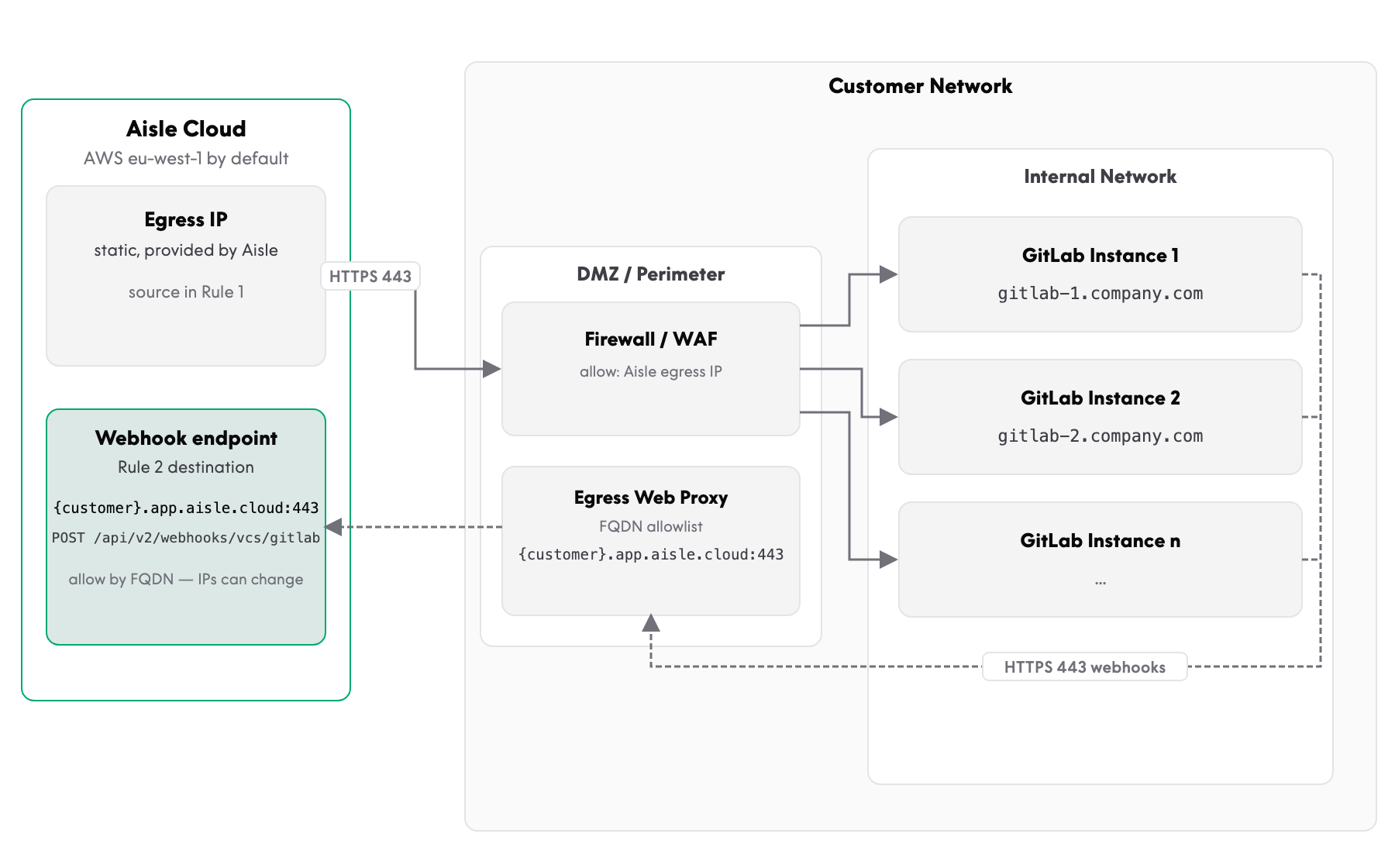
Figure 1 — Network flow. Rule 1 (solid line): Aisle to GitLab over HTTPS 443 for API v4 and Git. Rule 2 (dashed line): GitLab webhooks to Aisle through the egress proxy, allowed by FQDN.
Detailed firewall rule specifications
Rule 1 — Aisle to GitLab (API and Git operations)
Rule name |
|
|---|---|
Action | ALLOW |
Direction | INBOUND (to the customer network) |
Source IP(s) | <Provided by Aisle> |
Source port | Any (ephemeral) |
Destination | All GitLab FQDNs (see the table below) |
Destination port | 443 |
Protocol | TCP / HTTPS / TLS 1.2+ |
Description | Aisle VCS integration — API and Git operations |
More than one GitLab instance (grouped)
If you have more than one GitLab instance, list all destinations in one rule:
Instance name | FQDN | Public IP |
|---|---|---|
GitLab-1 |
| example: 203.0.113.10 |
GitLab-2 |
| example: 198.51.100.20 |
Note: Enter the public IP that each FQDN resolves to from the internet. This is usually the WAF, the reverse proxy, or the load balancer address, not the internal server address.
Rule 2 — GitLab to Aisle (webhooks)
Rule name |
|
|---|---|
Action | ALLOW |
Direction | OUTBOUND (from the customer network) |
Source IP(s) | GitLab server IP(s) |
Source port | Any (ephemeral) |
Destination |
|
Destination port | 443 |
Protocol | TCP / HTTPS / TLS 1.2+ |
Description | GitLab webhook notifications to Aisle |
GitLab endpoints that Aisle uses
Aisle accesses these URL paths on your GitLab server(s):
Endpoint | Method | Path | Purpose |
|---|---|---|---|
Projects list | GET |
| List the accessible repositories |
Project details | GET |
| Get the repository data |
Branches | GET |
| List the branches |
Merge requests | GET / POST |
| List and make MRs |
Merge request | GET / PUT |
| Get, update, and close MRs |
MR commits | GET |
| Read the MR commit list |
MR comments (notes) | GET / POST / PUT / DELETE |
| PR bot comments on MRs |
MR diff comments | POST |
| PR bot line-level review comments |
Comment reactions | POST |
| Acknowledge PR bot commands |
Commit status | POST |
| Post the analysis status on commits |
Commit details | GET |
| Look up commits for the status reports |
Pipelines | GET |
| CI validation (polling fallback) |
Project members | GET |
| Resolve the MR commenter permissions |
Webhooks | GET / POST / PUT / DELETE |
| Control the webhooks |
Token data | GET |
| Validate the PAT |
Current user | GET |
| Get the authenticated user |
Git operations | GET / POST |
| Clone, fetch, and push (Git Smart HTTP) |
Aisle webhook endpoint
GitLab sends the webhook notifications to this Aisle endpoint:
URL |
|
|---|---|
Method | POST |
Content-Type |
|
Authentication |
|
Note: Aisle makes the webhooks automatically through the GitLab API, with the PAT. Aisle makes and controls the webhook secret.
Events sent
Event | Trigger | Purpose |
|---|---|---|
| A push to a branch (Aisle filters the branches on its side) | Start the incremental analysis after a merge |
| An MR opens, updates, merges, or closes | Start the automatic MR analysis (PR bot) |
| A comment on a merge request | Permit the PR bot commands |
| A pipeline status change | CI validation of the Aisle fix MRs |
Note: If GitLab cannot deliver the pipeline webhooks, CI validation gets the pipeline results from the GitLab API (polling) through Rule 1. The other events have no polling fallback.
Traffic flow sequence
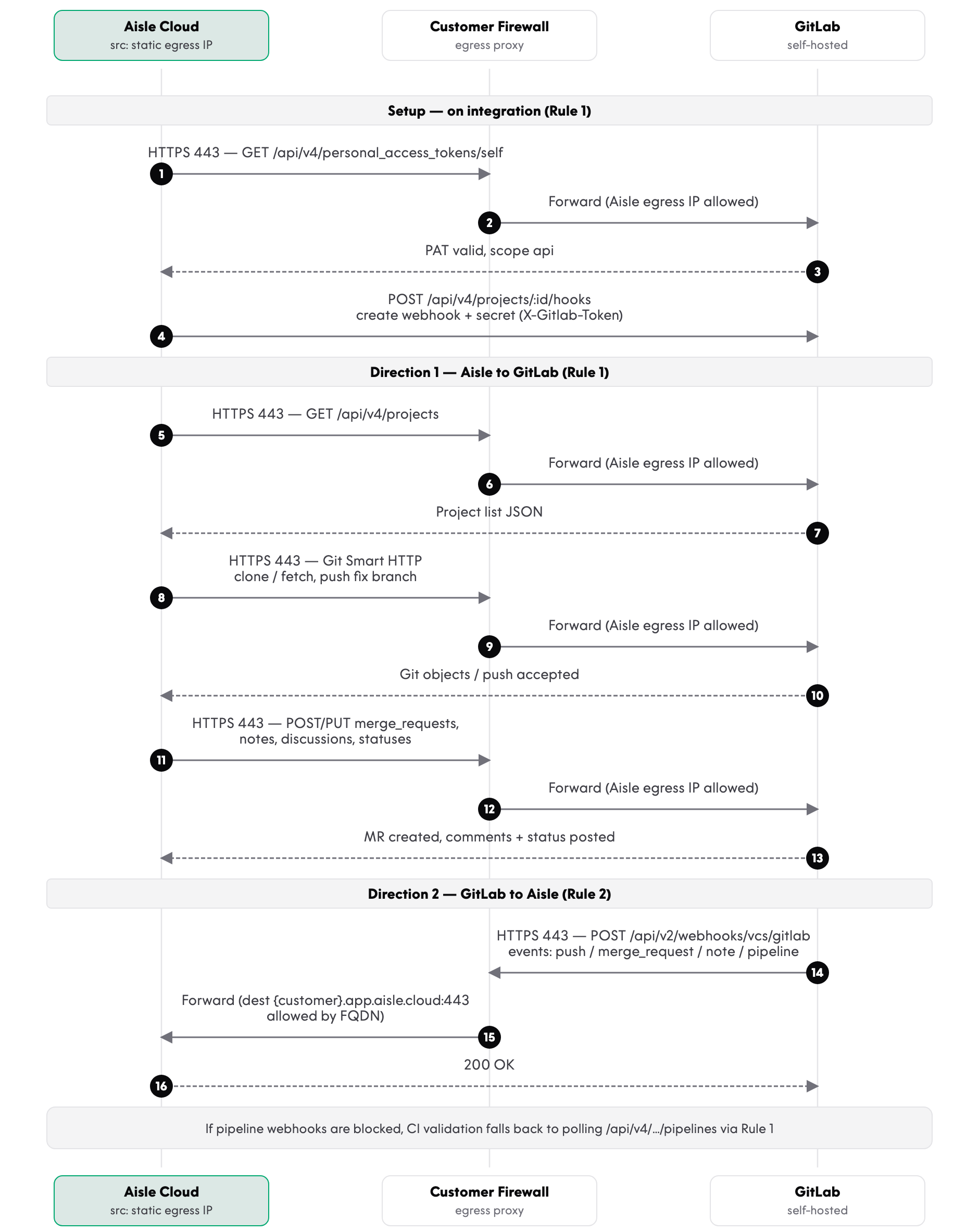
Figure 2 — Traffic flow sequence across Aisle Cloud, the customer firewall or egress proxy, and self-hosted GitLab.
WAF / reverse proxy configuration
If your GitLab instance is behind a Web Application Firewall (WAF) or a reverse proxy, permit the URL patterns and the HTTP methods that follow.
Permitted URL patterns (inbound to GitLab)
/api/v4/projects*
/api/v4/personal_access_tokens/self
/api/v4/user
/*.git/*
Necessary HTTP methods
Path pattern | Methods |
|---|---|
| GET, POST, PUT, DELETE |
| GET |
| GET |
| GET, POST (Git Smart HTTP) |
Note: Aisle uses all four HTTP methods under /api/v4/projects*: MR updates, review comments, commit statuses, and webhook control.
Possible WAF rule considerations
Rule category | Reason |
|---|---|
Request body size limits | Git push operations can have large payloads |
Rate limits | Repository synchronization can send bursts of requests |
Bot detection | Server-to-server traffic has no browser fingerprint |
(SQL) injection rules | API paths contain |
Outbound WAF / proxy (for the webhooks)
Permitted destination |
|
|---|---|
Port | 443 |
Method | POST |
Path |
|
Per-instance checklist
For each GitLab instance, make sure that these conditions are true:
The instance FQDN resolves from the internet (public DNS).
The TLS certificate is valid and comes from a public CA.
The firewall rule includes this instance.
The
external_urlsetting contains the public DNS name, not an internal name.
GitLab SaaS
For GitLab SaaS (gitlab.com), no firewall rules are necessary. Aisle connects to gitlab.com directly, and GitLab sends the webhooks to Aisle directly. Your network is not part of these flows.
One exception exists. GitLab Premium and Ultimate groups can restrict access by IP address (the group setting Restrict access by IP address). If your top-level group uses this restriction, add the Aisle egress IP addresses to the permitted list. For more data, see Restrict group access by IP address.